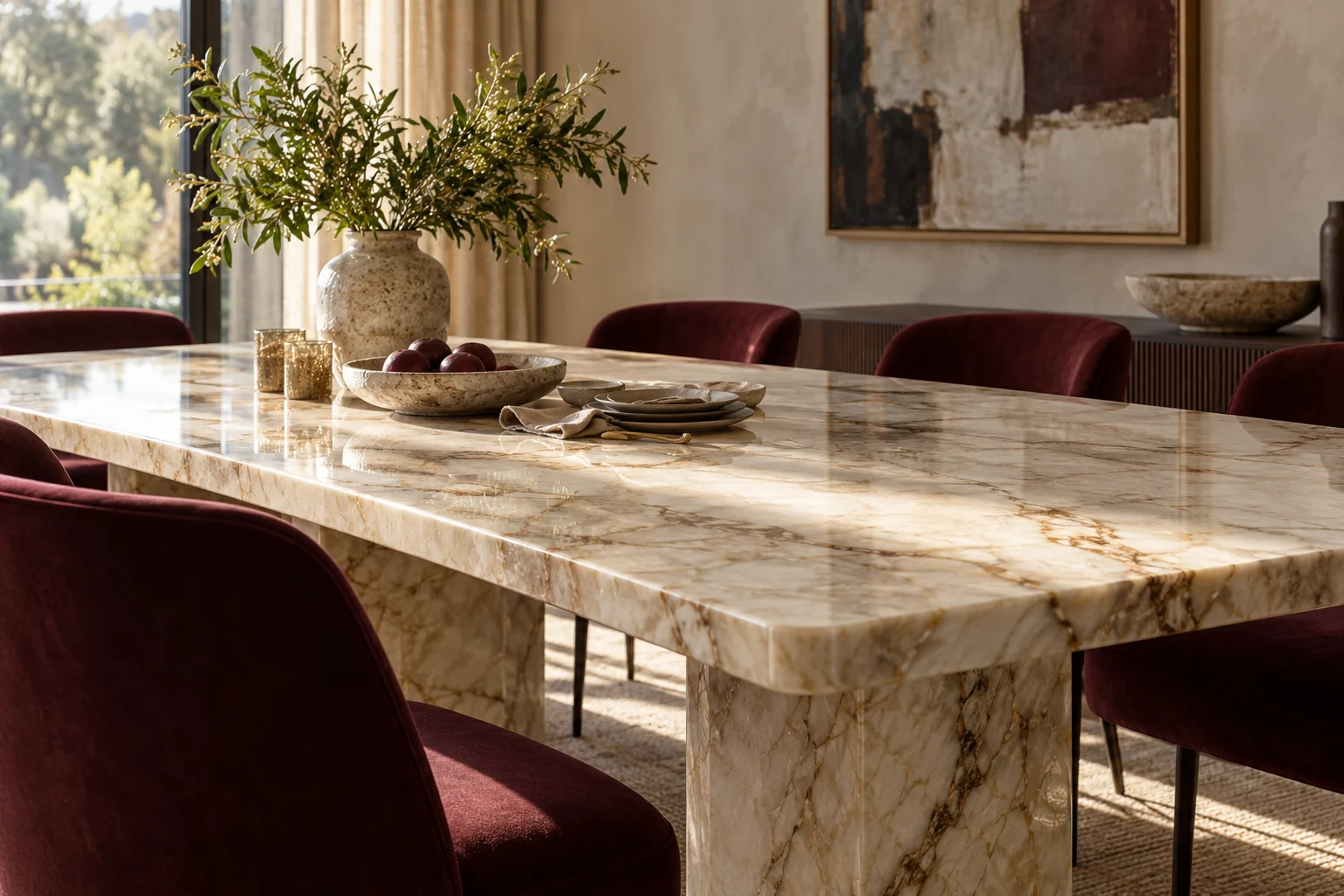
Identify the construction
Tell us whether the top is solid stone, a veneer or a composite construction. Share photos underneath where possible without moving a heavy top. Existing cracks, loose fixings or unsupported areas are structural concerns and need their own assessment; film cannot stabilise them.
Capture the outline
For a rectangular table, supply length and width. For a round top, give the diameter. For an oval or irregular top, include a simple sketch with the largest dimensions. Photograph the edge and corners clearly so the proposed coverage can be discussed.
Think about the viewing angle
Dining surfaces are often seen under pendants and strong side light. The finish may look different from a kitchen worktop. Ask about sample availability and discuss where seams or termination lines might sit before making a decision.
Care for the complete table
Continue using coasters, placemats and heat protection as appropriate. Follow the film manufacturer’s care guidance and keep sharp objects off the surface. If the table is relocated, protect its structure and edges; a surface film is not protection against moving damage.
Ready to discuss your project?
Send your photos and details. We confirm suitability, scope and pricing before work or supply is booked.
Start an enquiry ↗